SPY and VOO are 2 of the most popular S&P 500 ETFs. Warren Buffett has advised DIY retail investors to simply buy a low-cost S&P 500 index fund and sit back and relax. Here we'll look at how to invest in the S&P 500 with 2 ETFs and why you might want one over the other.
Disclosure: Some of the links on this page are referral links. At no additional cost to you, if you choose to make a purchase or sign up for a service after clicking through those links, I may receive a small commission. This allows me to continue producing high-quality content on this site and pays for the occasional cup of coffee. I have first-hand experience with every product or service I recommend, and I recommend them because I genuinely believe they are useful, not because of the commission I may get. Read more here.
In a hurry? Here are the highlights:
- SPY and VOO are two popular ETFs for the S&P 500 Index from State Street SPDR and Vanguard respectively.
- Both SPY and VOO hold the same S&P 500 stocks, so what you own is identical. The wrapper differs.
- SPY costs 0.09%. VOO costs 0.03%.
- SPY is a unit investment trust, a 1993 legal structure. It can't reinvest dividends inside the fund or lend out its securities. VOO, which launched in 2010, is a share class of a regular open-end fund and has no such limits.
- Over the past decade, VOO has trailed the index by about 0.04% a year, while SPY has trailed by about 0.16%.
- VOO has outperformed SPY historically as a result of all this.
- SPY trades far more shares than VOO and has a huge options market, i.e. greater liquidity. That's why traders and institutions prefer it.
- Retail buy-and-hold investors should prefer VOO for its lower fee and lack of cash drag.
- If you already own SPY in a taxable account with big gains, don't sell it just to switch. Point new money at VOO instead.
- State Street also has SPYM, its cheaper alternative for the S&P 500, which costs 0.02%.
Contents
SPY vs. VOO – Quick Comparison Table
Before we get into the details, here's a quick comparison table of SPY vs. VOO:
| SPY | VOO | |
|---|---|---|
| Name | State Street SPDR S&P 500 ETF Trust | Vanguard S&P 500 ETF |
| Issuer | State Street (SPDR) | Vanguard |
| Expense Ratio | 0.09% | 0.03% |
| Structure | Unit investment trust (UIT) | ETF share class of an open-end fund |
| Inception | January 1993 | September 2010 |
| Assets | $818 billion | $1.05 trillion (ETF share class) |
| Dividends (Fund) | Held as cash until quarterly payout | Can stay invested |
| Dividend Frequency | Quarterly | Quarterly |
| Daily Volume | 44 million shares | 7 million shares |
| Bid-ask Spread | ~0.001% | ~0.004% |
| Options Market | Deepest ETF options market in the world | Listed, but far thinner |
| Tracking Error | ~0.16 points/yr behind | ~0.04 points/yr behind |
| Best For | Traders, options users, institutions | Buy-and-hold investors |
Data as of September 2026. Sources: State Street, Vanguard.
Introduction – What Is the S&P 500 Index?
First, let's talk about the index that SPY and VOO both track.
The S&P 500 Index, the modern shorthand name of the Standard & Poor's 500 Index, is simply a curated collection of the 500 largest publicly traded companies in the United States based on total market capitalization. Market cap weighting just means the bigger the company, the larger its weight within the fund.
The index as we know it today was started in 1957. It is probably the most followed stock index, including household names like Apple, Amazon, Disney, Google, Microsoft, Johnson & Johnson, etc. These components are weighted in the index by their size, with the top 10 holdings making up over 25% of the index.
Because the index comprises roughly 82% of the total U.S. stock market and spans all market sectors, it is used as a proxy and benchmark for “the market” as a whole. Whether you're a beginner or a seasoned investor, the S&P 500 index is a reliable cornerstone of a long-term buy-and-hold investment strategy, providing broad diversification and relatively low risk within U.S. equities. If you've arrived on this page, you likely already know those facts.
You can't buy an index directly. You buy a fund that tracks it. Index funds come as mutual funds or exchange traded funds (ETFs), and ETFs have been steadily taking market share. Dozens of ETFs track the S&P 500, but two typically dominate the conversation: SPY and VOO.
SPY is the oldest, most highly traded ETF, boasting over $800B in assets. SPDR launched this ETF in 1993. SPY is so ubiquitous that investors sometimes colloquially refer to the S&P 500 Index itself as “SPY.”
Jack Bogle, considered by many to be “the father of index investing,” founded the brokerage firm Vanguard. Vanguard is famous for offering some of the cheapest index funds in the game. VOO is Vanguard's ETF to track the S&P 500 index. It launched in 2010.
Both are huge, both are affordable, and both are held by millions of investors. Here we'll primarily look at how they differ.
SPY vs. VOO – Similarities
So again, SPY and VOO are both popular ETFs that track the S&P 500 Index.
Thankfully, to invest in the S&P 500 index, you don't have to buy the 500 companies' stocks individually. But you also can't buy an index directly. You need an index fund – a fund that tracks the index. Index funds come in the form of mutual funds or ETFs (Exchange Traded Funds). The latter is now starting to replace the former.
Because the S&P 500 index is so popular, there are quite a few ETFs that track the index, hold those underlying stocks, and trade as a single security/ticker, all at low fees. By buying shares of a single fund, you can own all 500 companies in the index.
Proponents of passive, buy-and-hold index investing like Warren Buffett, Jack Bogle, and many others suggest simply finding a highly liquid, low-cost index fund to access the S&P 500 index as the core holding in one's stocks portfolio. SPY and VOO are two extremely popular ETFs to do just that.
Since these funds employ passive replication of the index as opposed to active management, they have low fees and high liquidity. All you have to do is buy shares of one of the ETFs below through an online broker and you can say you are invested in the S&P 500.
So similarity-wise, in summary, both SPY and VOO are ETFs that track the S&P 500, are affordable, and are very popular.
SPY vs. VOO – Differences
Now let's talk about the differences between SPY and VOO.
The differences aren't about what you own. Again, they're both basically the same 500 stocks. The differences concern how the fund is legally structured, what it costs, how it handles cash, and how it trades. Those differences are arguably small, but they're real. I'll walk you through them one by one.
Issuer
SPY is the State Street SPDR S&P 500 ETF Trust. VOO is the Vanguard S&P 500 ETF. As you can see from the names, they come from two different providers.
This doesn't matter too much here, as both are very popular and liquid, but it's arguably worth noting that Vanguard is shareholder-owned while State Street is not.
Vanguard is owned by its own funds, and those funds are owned by the people who invest in them, so there are no outside stockholders to pay. It runs “at cost” and passes the savings back through lower expense ratios. In other words, this typically shows up practically with Vanguard always trying to lower fees on its funds whenever possible.
State Street Corporation is a publicly traded company owned by its stockholders. Its asset management arm is expected to earn a profit for them.
Many investors find that structural incentive of Vanguard comforting over the long haul, and it's a big part of why Bogleheads are so loyal to it.
Structure
Now let's cover the legal structure of each fund.
SPY launched in January 1993 as a unit investment trust (UIT). That was the only legal structure that made the first-ever ETF possible at the time.
VOO, by contrast, is an exchange-traded share class of the Vanguard 500 Index Fund that launched in 2010 as a regular open-end ETF that also has mutual fund share classes (like VFIAX).
That 1993 structure comes with some quirky restrictions that don't apply to VOO:
1. SPY can't reinvest dividends between payouts (the “cash drag”). When Apple or Microsoft pays SPY a dividend, that cash goes into a non-interest-bearing account and just sits there until SPY's next quarterly distribution. So a dividend received early in a quarter can sit idle for close to three months. In a rising market, idle cash is a drag. In a falling market, it's a tiny cushion. Because markets rise more often than they fall, which is why we're investing in the first place, the drag usually wins over the long run. VOO has no such restriction and stays essentially fully invested.
How big is that drag? The classic study is Elton, Gruber, Comer, and Li, “Spiders: Where Are the Bugs?” in the Journal of Business from 2002. They found SPY trailed the S&P 500 by about 28 basis points a year in its early days, with roughly 10 basis points of that traced to the lack of dividend reinvestment.
Back then, the index yielded around 2%. The index yields closer to 1% today at the time of writing in late 2026, so you'd expect the dividend drag to be roughly half as large now, around 5 basis points.
2. SPY can't lend its securities. Open-end funds can lend shares to short sellers and earn a fee, and many comparisons list this as a VOO advantage, though for this particular fund, the tangible difference is negligible, as securities lending income on the Vanguard 500 Index rounds to zero, because these are the most liquid stocks in the world; no one is paying to borrow them. So technically an advantage but practically nothing.
3. SPY can't use derivatives. Its prospectus says it doesn't hold or trade futures or swaps. Open-end index funds can use index futures to keep small cash balances working. At this scale, though, again, that's largely immaterial.
4. SPY has an expiration date. This is a fun fact. SPY is scheduled to terminate no later than January 22, 2118, or earlier, 20 years after the death of the last survivor of eleven people named in the trust agreement. It's a funny piece of trust law, and the agreement can be amended, so nobody reading this will be around for it. This is the fun fact for your next dinner party.
Fees
The difference in fee between SPY and VOO is arguably the most glaring characteristic. The fee is expressed as a percentage of invested assets and is called the expense ratio. SPY costs 0.09% while VOO costs 1/3 of that at 0.03%. (SPY is actually 0.0945%, but we colloquially round down.)
Here's how that fee difference shakes out for different amounts invested annually:
| Amount Invested | SPY (0.0945%) | VOO (0.03%) | Extra Cost of SPY |
|---|---|---|---|
| $10,000 | $9.45 | $3.00 | $6.45 |
| $100,000 | $94.50 | $30.00 | $64.50 |
| $1,000,000 | $945.00 | $300.00 | $645.00 |
| $5,000,000 | $4,725.00 | $1,500.00 | $3,225.00 |
At $5M, SPY's fee is $3,225 a year more than VOO's for the same 500 stocks. Over a decade, even with no growth, that's over $32,000.
Here's what those same figures look like extended over 30 years:
| Amount Invested | VOO Fees | SPY Fees | Extra cost of SPY |
|---|---|---|---|
| $10,000 | $282 | $878 | $596 |
| $100,000 | $2,819 | $8,776 | $5,957 |
| $1,000,000 | $28,186 | $87,762 | $59,576 |
| $5,000,000 | $140,929 | $438,810 | $297,881 |
To add insult to injury, this is only the fee gap and doesn't even include SPY's trailing VOO by roughly 0.12 points a year, about twice the fee gap. We'll look at this shortly.
You might be interested in seeing where SPY's fee actually goes and what makes it more expensive. According to its prospectus, the breakdown looks like this:
| SPY Fee Component | % of Net Assets |
|---|---|
| Trustee fee | 0.0492% |
| S&P license fee | 0.0301% |
| Marketing | 0.0132% |
| Other operating expenses | 0.0020% |
| Total | 0.0945% |
SPY's S&P license fee by itself is roughly equal to VOO's entire expense ratio. The trustee has also agreed to cap SPY's expenses at 0.0945% through at least February 1, 2027, so don't hold your breath for a fee cut.
SPY's main customers are traders and institutions who care far more about liquidity than six basis points. Though State Street does have SPYM, which is their answer for cost-conscious buyers. I covered it in a separate post here.
Tracking Difference
Both SPY and VOO track the same index, so their gross returns are nearly identical. But how closely does each one match the index itself? The difference between the fund's NAV and the index it's attempting to track is called the tracking difference. Here are the annualized returns at NAV through June 30, 2026, per each issuer:
| Period | S&P 500 | VOO | SPY | VOO vs. Index | SPY vs. Index |
|---|---|---|---|---|---|
| 1 year | 22.32% | 22.28% | 22.15% | -0.04 | -0.17 |
| 3 years | 20.61% | 20.58% | 20.46% | -0.03 | -0.15 |
| 5 years | 13.41% | 13.36% | 13.26% | -0.05 | -0.15 |
| 10 years | 15.51% | 15.47% | 15.35% | -0.04 | -0.16 |
VOO has trailed the index by roughly its expense ratio, which is about what we'd expect from a well-run index fund.
SPY has trailed by 0.15 to 0.17 points, which is its 0.0945% fee plus an extra five to seven basis points. That extra slice is consistent with the dividend cash drag we touched on earlier.
SPY vs. VOO Performance
Now we can visualize that aforementioned fee difference combined with the tracking difference in a performance graph using a backtest going back to VOO's inception in 2010 and looking through mid-2026:
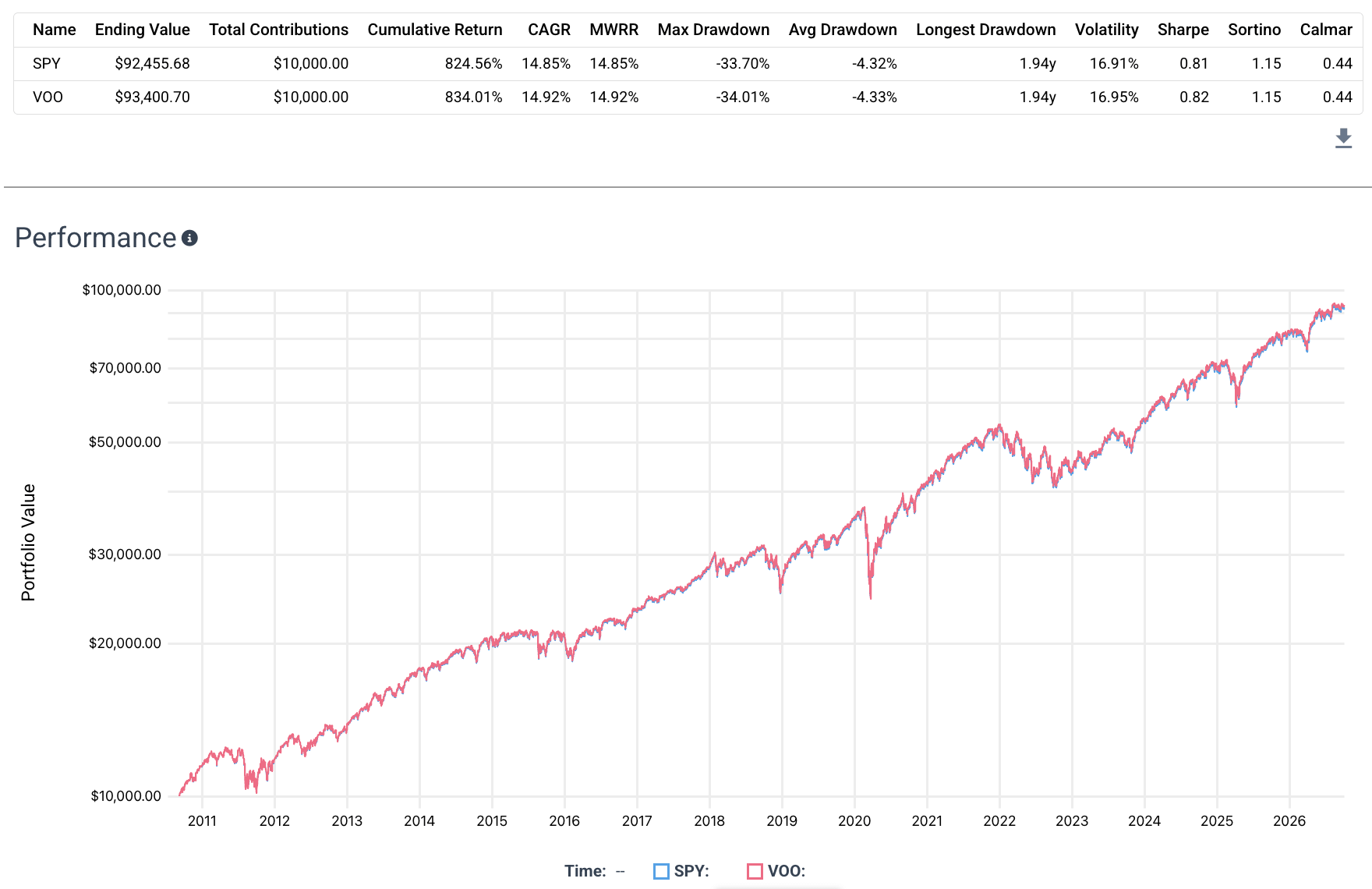
Notice how that CAGR shows the result of all the numbers in the table above.
Liquidity, Volume, and Spreads – Where SPY Really Wins
At this point, you might be wondering why anyone would ever buy SPY over VOO. This section is where SPY finally scores some points.
SPY trades roughly 44 million shares a day versus about 7 million for VOO. At current prices, that's tens of billions of dollars a day for SPY against roughly a fifth of that for VOO. Despite being one of the largest ETFs by assets, VOO barely cracks the top 10 by daily volume.
Spread is the difference between what sellers are asking for and what buyers are offering for any trade. Spreads tell the same story of liquidity, or tradability. SPY's spread is often a single penny at 0.001%. VOO's median spread runs about 0.004%.
What that means in dollars is a round trip (buying and selling) of $10,000 costs roughly $0.13 in spread on SPY and about $0.40 on VOO. The annual fee difference on that same $10,000 is $6.45. You'd have to round-trip your entire position about 25 times a year before SPY's tighter spread made up for its higher fee. If that describes you, you're a trader, not an investor, and SPY is probably your fund.
For institutions moving hundreds of millions of dollars in seconds, SPY's depth matters. For someone buying $500 a month, both funds are effectively perfectly liquid. An ETF's real liquidity comes from the underlying stocks, and these two own the most liquid stocks on earth.
The same consideration applies to options trading. If you trade options, you'd be more interested in SPY's greater number of expirations and tighter spreads.
This is why you hear people say SPY is for institutions and traders while VOO is for retail buy-and-holders.
Taxes – Capital Gains, In-Kind Redemptions, and Vanguard's Patent
Both SPY and VOO are very tax-efficient, mainly because of how ETFs handle redemptions.
When large institutions redeem ETF shares, the fund hands over stocks instead of selling them for cash. That lets the fund flush out its lowest-cost-basis shares without realizing a taxable gain. It's a big reason ETFs have a structural tax edge over traditional mutual funds.
VOO has an extra tidbit. Because it's a share class of a mutual fund, the ETF share class lets the whole fund, including mutual fund share classes like VFIAX, use in-kind redemptions to purge gains. Vanguard's financial statements show no capital gains distributions from the 500 Index Fund from 2021 through the first half of 2026, and the fund held a large capital loss carryforward at the end of 2025. Barring something strange, capital gains distributions from VOO aren't a realistic worry.
SPY also hasn't paid capital gains distributions in recent years. For most investors, the tax difference between the two funds is effectively zero. Dividends from both are mostly qualified dividends.
Lastly, I've seen some online sources imply that SPY options get the favorable Section 1256 60/40 tax treatment, where 60% of gains count as long-term and 40% as short-term regardless of how long you held, but this is not true. That treatment applies to index options like SPX itself. SPY options are options on ETF shares, so they're taxed like any other equity option, based on your holding period. The same goes for VOO options.
Tax Loss Harvesting – Can You Swap SPY and VOO?
This question comes up constantly on Bogleheads and Reddit. The short answer is it's a gray area and no one knows for sure.
Tax loss harvesting means realizing a loss to offset gains or taxable income. I have a separate post on it here. A common strategy is to buy a substitute fund at the same time to avoid staying in cash.
The IRS's wash sale rule disallows a loss if you buy a “substantially identical” security within 30 days before or after selling at a loss, but the IRS has never defined “substantially identical” for funds.
Some investors argue that different issuers and different legal structures are enough. Others argue that two funds tracking the same index with nearly identical holdings are about as close to “substantially identical” as two securities can get.
SPY and VOO come from different providers and are different structures but they track the exact same index, so ask a CPA.
What About IVV and SPYM?
The elephant in the room is SPYM, State Street's cheaper S&P 500 fund that is cheaper than both SPY and VOO at 0.02%. I covered it here.
Like VOO, SPYM is more for retail buy-and-hold investors, and traders would still prefer SPY.
IVV, the iShares Core S&P 500 ETF, is the other big S&P 500 ETF. It charges 0.03%, is an open-end fund, and is, for all intents and purposes, interchangeable with VOO. If your broker favors iShares or you simply prefer BlackRock, IVV is a perfectly good choice.
SPY vs. VOO – The Verdict
Both SPY and VOO will get you the S&P 500, so you can't go badly wrong with either. But the differences all point the same way for a long-term investor. VOO is cheaper, has tracked the index more closely, is at least as tax-efficient, and doesn't carry the quirks of an outdated trust structure. If you're buying and holding in a 401(k), IRA, HSA, or taxable account, VOO is the better pick. I'm partial to Vanguard, so I own VOO myself.
SPY makes sense if you trade frequently, use options such as covered calls, spreads, move very large sums at once, or need the deepest liquidity available for hedging. In those cases, SPY's volume and options chain are worth more than 0.06%.
And if you already own SPY in a taxable account with large gains, it's probably not worth it to sell just to switch, as the tax bill would likely outweigh the fee savings. Keep it, and put your new contributions into VOO.
All these S&P 500 ETFs discussed should be available at any major broker. My choice is M1 Finance. The online broker has zero transaction fees and offers fractional shares, dynamic rebalancing, and a modern, user-friendly interface and mobile app. I wrote a comprehensive review of M1 Finance here.
Disclosures: I am long VOO in my own portfolio.
Interested in more Lazy Portfolios? See the full list here.
Disclaimer: While I love diving into investing-related data and playing around with backtests, this is not financial advice, investing advice, or tax advice. The information on this website is for informational, educational, and entertainment purposes only. Investment products discussed (ETFs, mutual funds, etc.) are for illustrative purposes only. It is not a research report. It is not a recommendation to buy, sell, or otherwise transact in any of the products mentioned. I always attempt to ensure the accuracy of information presented but that accuracy cannot be guaranteed. Do your own due diligence. I mention M1 Finance a lot around here. M1 does not provide investment advice, and this is not an offer or solicitation of an offer, or advice to buy or sell any security, and you are encouraged to consult your personal investment, legal, and tax advisors. Hypothetical examples used, such as historical backtests, do not reflect any specific investments, are for illustrative purposes only, and should not be considered an offer to buy or sell any products. All investing involves risk, including the risk of losing the money you invest. Past performance does not guarantee future results. Opinions are my own and do not represent those of other parties mentioned. Read my lengthier disclaimer here.

Are you nearing or in retirement? Use my link here to get a free holistic financial plan and to take advantage of 25% exclusive savings on financial planning and wealth management services from fiduciary advisors at Retirable to manage your savings, spend smarter, and navigate key decisions.


A couple things.
1. I don’t know what liquidity has to do with it, but suppose I implement a strategy where I periodically move between S&P and another index. Is SPY the correct choice? (The strategy is dual momentum where I plan to experiment a small portion of the portfolio)
2. When writing about IVV, you mention tax loss harvesting. But it’s my understanding that all three of these funds track the same index and therefore would be identical. I don’t know that this would really avoid a wash sale.
1. Any of the 3 would work for this, assuming the same spread, which is a common measure of liquidity.
2. IRS has never explicitly defined wash sale. Different providers. Probably fine. Or just use VTI, IWB, VONE, etc. to be sure.
In looking at VOO v IVV for a taxable account, it would seem IVV may be the better choice since it seem to minimizes capital gains and instead, tends to only deliver qualified dividends to reduce tax burden. Would you agree?
Haven’t looked into the precise tax cost of these funds. They should be similar; they track the same index.
I haven’t checked every year, but on some years at least the tracking error on VOO was EXACTLY the difference in expense ratio between VOO and SPY. Furthermore SPY has a tighter spread.
What about SPLG?
That one works too, though it’s much less popular than the others listed here.
SPLG is gone and is now SPYM
SPLG also track S&P 500 and the expense ratio is also 0.03%
True, thanks for pointing it out! It’s much less popular than the others listed here.
SPLG is gone and is now SPYM
You should consider adding FNILX. With a 0% expense ratio and it maps to the S&P 500 I would recommend it over these
Thanks for the comment, Ross. FNILX is a mutual fund, and is only able to be bought and held at Fidelity. Also note that FNILX does not track the S&P 500 Index, though it should be a comparable investment.