• Skip to main content
  • Skip to secondary menu
  • Skip to primary sidebar
  • Skip to footer

Optimized Portfolio

Investing and Personal Finance

  • Start Here
  • Investing 101
    • Beginners Start Here – 10 Steps To Start Building Wealth
    • What Is the Stock Market? How It Works & How to Invest in It
    • How To Invest in an Index Fund – The Best Index Funds
    • Portfolio Asset Allocation by Age
    • How To Invest Your Emergency Fund
    • Portfolio Diversification – How To Diversify Your Portfolio
    • Dollar Cost Averaging vs. Lump Sum Investing (DCA vs. LSI)
    • How To Invest Your HSA (Health Savings Account)
    • Factor Investing and Factor ETFs – The Ultimate Guide
    • more…
  • Lazy Portfolios
    • All Weather Portfolio
    • Bogleheads 3 Fund Portfolio
    • HEDGEFUNDIE’s Excellent Adventure
    • Warren Buffett Portfolio
    • Golden Butterfly Portfolio
    • Paul Merriman Ultimate Buy and Hold Portfolio
    • Ben Felix Model Portfolio
    • Permanent Portfolio
    • David Swensen Portfolio
    • 60/40 Portfolio
    • more…
  • Funds
    • VOO vs. VTI – Vanguard S&P 500 or Total Stock Market ETF?
    • The 7 Best International ETFs
    • The 8 Best Small Cap ETFs (4 From Vanguard)
    • The 5 Best REIT ETFs
    • The 5 Best EV ETFs – Electric Vehicles ETFs
    • VIG vs. VYM – Comparing Vanguard’s 2 Popular Dividend ETF’s
    • The Best Vanguard Dividend Funds – 4 Popular ETFs
    • The 5 Best Tech ETFs
    • The 7 Best Small Cap Value ETFs
    • The 6 Best ETFs for Taxable Accounts
    • The 5 Best Emerging Markets ETFs (1 From Vanguard) for 2023
    • more…
  • Leverage
    • What Is a Leveraged ETF and How Do They Work?
    • How To Beat the Market Using Leverage and Index Investing
    • The 9 Best Leveraged ETFs
    • Hedgefundie’s Excellent Adventure
    • Leveraged All Weather Portfolio
    • Leveraged Permanent Portfolio
    • Leveraged Golden Butterfly Portfolio
    • NTSX – Review and Summary
    • TQQQ – Is It A Good Investment?
    • PSLDX – A Review
    • SWAN – A Review
    • RPAR Risk Parity ETF Review
    • more…
  • Dividends
    • The Best M1 Finance Dividend Pie
    • The 11 Best Dividend ETFs
    • The Best Vanguard Dividend Funds – 4 Popular ETFs
    • VIG vs. VYM – Comparing Vanguard’s 2 Popular Dividend ETF’s
    • 8 Reasons Why I’m Not a Dividend Income Investor
    • QYLD – A Harsh Review
    • more…
  • Brokers
    • The 5 Best Stock Brokers
    • The 4 Best Investing Apps
    • M1 Finance Review
    • Brokers with the Lowest Margin Rates
    • M1 Finance vs. Fidelity
    • M1 Finance vs. Vanguard
    • Webull vs. Robinhood
    • Stash vs. Robinhood
    • M1 Borrow Review (How M1’s Margin Loan Works)
    • more…
  • Retirement
    • The 10 Best ETFs for Retirement Portfolios in 2023
    • The 4% Rule for Retirement Withdrawal Rate – A Revisitation
    • Sequence of Return Risk in Retirement Explained
    • Traditional IRA Explained
    • Roth IRA Explained
    • 401k vs. Roth IRA
    • Roth IRA vs. Traditional IRA
    • Backdoor Roth IRA Explained
    • more…
  • My Toolbox

ETF vs. ETN vs. ETP – Differences, Similarities, Risks, Etc.

Last Updated: April 4, 2023 No Comments – 3 min. read

ETF. ETN. ETP. So many initialisms. Here we'll explore what these things are and what differences exist among them.

Disclosure:  Some of the links on this page are referral links. At no additional cost to you, if you choose to make a purchase or sign up for a service after clicking through those links, I may receive a small commission. This allows me to continue producing high-quality content on this site and pays for the occasional cup of coffee. I have first-hand experience with every product or service I recommend, and I recommend them because I genuinely believe they are useful, not because of the commission I may get. Read more here.

Contents

  • Video
  • ETF vs. ETN vs. ETP – What Do the Letters Mean?
  • ETF vs. ETN – Similarities, Differences, and Risks

Video

Prefer video? Watch it here:

ETF vs. ETN vs. ETP – What Do the Letters Mean?

First, here's what these initialisms stand for:

ETF – Exchange Traded Fund
ETN – Exchange Traded Note
ETP – Exchange Traded Product

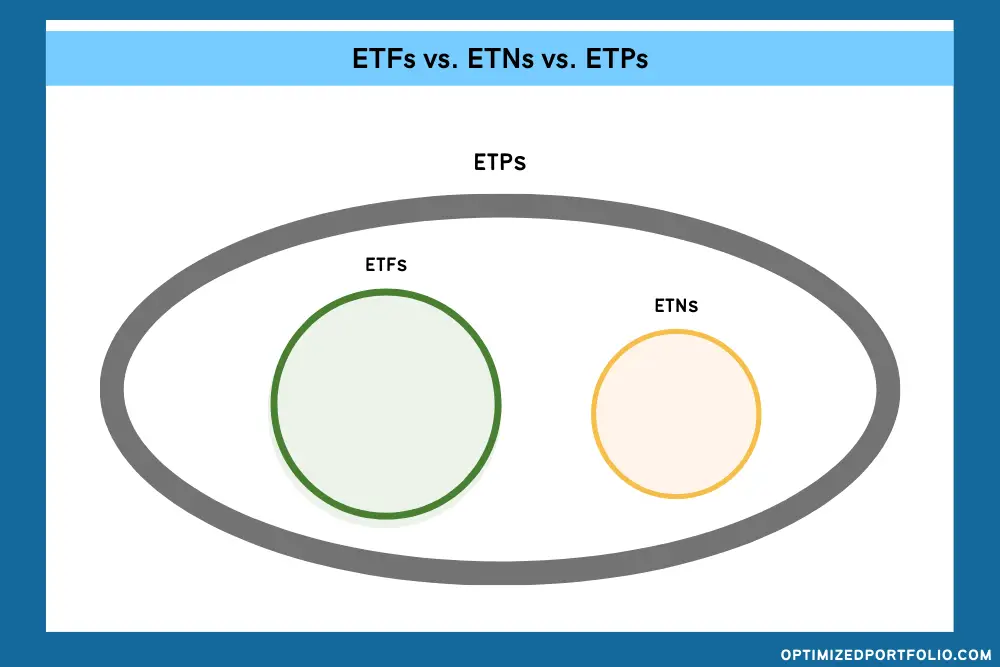
Secondly, I created this crude Venn diagram to illustrate the relationship among them:
etf vs etn vs etp

Basically, ETP describes all exchange-traded products, which includes ETFs and ETNs. So ETFs and ETNs are just two types of ETPs. Put another way, all ETFs are ETPs, but not all ETPs are ETFs. Say that 5 times fast.

ETF vs. ETN – Similarities, Differences, and Risks

You've probably heard of ETFs. They're very popular. They almost always track some index (index funds), such as the famous S&P 500. ETFs are an alternative to mutual funds, and are quickly replacing mutual funds. In buying an ETF, you're buying a fund that holds the assets from the index it tracks. As the name suggests, ETFs trade on exchanges just like stocks.

ETNs are less prevalent and less popular. They are a relatively new product; they were first created in 2006. Like ETFs, ETNs trade on an exchange, track some index, and usually have lower fees than an actively managed fund. Unlike ETFs, however, ETNs are unsecured debt instruments. You can remember this if you think of the word “note” as a piece of paper.

Think of an ETN like a corporate bond. This means the ETN is issued by some institution, which carries what we call counterparty risk. This is the main difference between ETFs and ETNs that investors pay attention to. Essentially, if the issuer of the ETN goes under, there's a chance you could lose all the money you put into it, whereas with an ETF, the shares would simply be liquidated at their market value. With the ETF, you still own the underlying assets. With the ETN, there are no assets. Also, since ETNs are less popular, there may be liquidity risk as well; all things being equal, an ETF will likely be easier to sell than an ETN.

ETNs do have some arguably advantages, though. They don't buy or sell any underlying assets like ETFs do and they don't have dividends or distributions, so there are no taxes or trading costs associated. The investor only incurs taxes upon selling the ETN. Moreover, since an ETN doesn't hold the assets, it doesn't have tracking error like ETFs do. Tracking error means the difference in price movement between the ETF and its index.

You may run into an asset – like gold, for example – where only ETNs are available. ETNs are commonly seen for things like commodities and currencies that are harder for retail investors to buy directly.This is why they were invented in the first place. Just know that in buying an ETN, you are taking on extra counterparty risk in that you are subject to the credit rating of the issuer, so while it's rare, there exists a non-zero probability of default. Always check out the trading volume of an ETN and the credit rating of its issuer before buying one.

As you can see, ETNs are a bit more complicated than ETFs. ETFs are easier to understand. Simplicity in portfolios is extremely valuable, particularly for new investors, so you should probably usually stick with ETFs whenever possible. Basically, only buy an ETN if it is the only product available for the asset you want.


Interested in more Lazy Portfolios? See the full list here.

Disclaimer:  While I love diving into investing-related data and playing around with backtests, this is not financial advice, investing advice, or tax advice. The information on this website is for informational, educational, and entertainment purposes only. Investment products discussed (ETFs, mutual funds, etc.) are for illustrative purposes only. It is not a research report. It is not a recommendation to buy, sell, or otherwise transact in any of the products mentioned. I always attempt to ensure the accuracy of information presented but that accuracy cannot be guaranteed. Do your own due diligence. I mention M1 Finance a lot around here. M1 does not provide investment advice, and this is not an offer or solicitation of an offer, or advice to buy or sell any security, and you are encouraged to consult your personal investment, legal, and tax advisors. Hypothetical examples used, such as historical backtests, do not reflect any specific investments, are for illustrative purposes only, and should not be considered an offer to buy or sell any products. All investing involves risk, including the risk of losing the money you invest. Past performance does not guarantee future results. Opinions are my own and do not represent those of other parties mentioned. Read my lengthier disclaimer here.
m1


Are you nearing or in retirement? Use my link here to get a free holistic financial plan and to take advantage of 25% exclusive savings on financial planning and wealth management services from fiduciary advisors at Retirable to manage your savings, spend smarter, and navigate key decisions.

retirement peace of mind

Related Posts

  • PSLDX – A Review of the PIMCO StocksPLUS® Long Duration Fund
  • Sequence of Return Risk in Retirement Explained
  • The 3 Best Silver ETFs – Funds for the Secondary Metal
  • The 6 Best AI ETFs To Bet on Artificial Intelligence in 2025
  • David Swensen Portfolio (Yale Model) Review and ETFs To Use

About John Williamson, APMA®

Analytical data nerd, investing enthusiast, fintech consultant, Boglehead, and Oxford comma advocate. I'm not a big fan of social media, but you can find me on LinkedIn and Reddit.

Reader Interactions

Leave a Reply Cancel reply

Your email address will not be published. Required fields are marked *

Primary Sidebar

  • Facebook
  • Instagram
  • Reddit
  • Twitter
  • YouTube
  • Patreon

Join 5,372 other investors

Take control of your financial future by subscribing to receive exclusive emails with expert tips, news, and notifications of new posts and important updates.

Don't worry, I hate spam too. No ads.

John Williamson, APMA®

Analytical data nerd, investing enthusiast, fintech consultant, Boglehead, and Oxford comma advocate. I'm not a big fan of social media, but you can find me on LinkedIn and Reddit. Read More…

Most Popular

Ray Dalio All Weather Portfolio Review, ETFs, & Leverage (2025)

HEDGEFUNDIE’s Excellent Adventure (UPRO/TMF) – A Summary

Golden Butterfly Portfolio Review and M1 Finance ETF Pie

David Swensen Portfolio (Yale Model) Review and ETFs To Use

55 Lazy Portfolios and Their ETF Pies for M1 Finance (2025)

VIG vs. VYM – Vanguard’s 2 Popular Dividend ETFs (Review)

Warren Buffett ETF Portfolio (90/10) Review and ETFs (2025)

Bogleheads 3 Fund Portfolio Review and Vanguard ETFs (2025)

Paul Merriman Ultimate Buy and Hold Portfolio Review & ETFs (2025)

The Best M1 Finance Dividend Pie for FIRE & Income Investors

m1 sidebar

retirable

Portfolio Asset Allocation by Age – Beginners To Retirees

The 7 Best Small Cap ETFs (3 From Vanguard) for 2025

9 Best International ETFs To Buy (6 From Vanguard) in 2025

The 3 Best Inverse ETFs to Short the S&P 500 Index in 2025

Ben Felix Model Portfolio (Rational Reminder, PWL) ETFs & Review

Factor Investing and Factor ETFs – The Ultimate Guide

NTSX ETF Review – WisdomTree U.S. Efficient Core ETF (90/60)

The Ginger Ale Portfolio (My Own Portfolio) and M1 ETF Pie

TQQQ – Is It A Good Investment for a Long Term Hold Strategy?

QYLD – Avoid This ETF as a Long-Term Investment (A Review)

The 9 Best T Bill ETFs (Treasury Bills) To Park Cash in 2025

JEPI ETF Review – JPMorgan Equity Premium Income ETF

SPAXX vs. FZFXX, FDIC, FCASH, FDRXX – Fidelity Core Position

Recent Posts

M1 Earn High Yield Cash Account Review – 4% APY (2025)

RSBY ETF Review – Return Stacked® U.S. Bonds & Futures Yield ETF

1 ETF for Life to Get Rich? It’s Not One You’d Guess…

How to Get 35% off a New Tesla Model Y (1.99% APR Financing Promo)

M1 Finance New Dividend Reinvestment Features Are Here! (Sneak Peek)

RSSY ETF Review – Return Stacked® U.S. Stocks & Futures Yield ETF

RSBT ETF Review – Return Stacked® Bonds & Managed Futures ETF

RSST ETF Review – Return Stacked® US Stocks & Managed Futures ETF

CAOS ETF Review – Alpha Architect Tail Risk ETF

How to Get 33% off a New Tesla Model Y (0.99% APR Promo)

CALF ETF Review – Pacer U.S. Small Cap Cash Cows 100 ETF

Is THIS the Best Portfolio?

AVMA ETF Review – Avantis Moderate Allocation ETF (60/40 + Factors)

COWZ ETF Review – Pacer U.S. Cash Cows 100 ETF

BOXX ETF Review – Alpha Architect 1-3 Month Box ETF

View All...

Footer

  • Facebook
  • Instagram
  • Reddit
  • Twitter
  • YouTube
  • Patreon

Amazon Affiliate Disclosure

OptimizedPortfolio.com is a participant in the Amazon Services LLC Associates Program, an affiliate advertising program designed to provide a means for sites to earn advertising fees by advertising and linking to Amazon.com.

Email Newsletter

Sign up to receive email updates when a new post is published.

Don't worry, I hate spam too. No ads.

About - My Toolbox - Privacy - Terms - Contact


Copyright © 2025 OptimizedPortfolio.com