• Skip to main content
  • Skip to secondary menu
  • Skip to primary sidebar
  • Skip to footer

Optimized Portfolio

Investing and Personal Finance

  • Start Here
  • Investing 101
    • Beginners Start Here – 10 Steps To Start Building Wealth
    • What Is the Stock Market? How It Works & How to Invest in It
    • How To Invest in an Index Fund – The Best Index Funds
    • Portfolio Asset Allocation by Age
    • How To Invest Your Emergency Fund
    • Portfolio Diversification – How To Diversify Your Portfolio
    • Dollar Cost Averaging vs. Lump Sum Investing (DCA vs. LSI)
    • How To Invest Your HSA (Health Savings Account)
    • Factor Investing and Factor ETFs – The Ultimate Guide
    • more…
  • Lazy Portfolios
    • All Weather Portfolio
    • Bogleheads 3 Fund Portfolio
    • HEDGEFUNDIE’s Excellent Adventure
    • Warren Buffett Portfolio
    • Golden Butterfly Portfolio
    • Paul Merriman Ultimate Buy and Hold Portfolio
    • Ben Felix Model Portfolio
    • Permanent Portfolio
    • David Swensen Portfolio
    • 60/40 Portfolio
    • more…
  • Funds
    • VOO vs. VTI – Vanguard S&P 500 or Total Stock Market ETF?
    • The 7 Best International ETFs
    • The 8 Best Small Cap ETFs (4 From Vanguard)
    • The 5 Best REIT ETFs
    • The 5 Best EV ETFs – Electric Vehicles ETFs
    • VIG vs. VYM – Comparing Vanguard’s 2 Popular Dividend ETF’s
    • The Best Vanguard Dividend Funds – 4 Popular ETFs
    • The 5 Best Tech ETFs
    • The 7 Best Small Cap Value ETFs
    • The 6 Best ETFs for Taxable Accounts
    • The 5 Best Emerging Markets ETFs (1 From Vanguard) for 2023
    • more…
  • Leverage
    • What Is a Leveraged ETF and How Do They Work?
    • How To Beat the Market Using Leverage and Index Investing
    • The 9 Best Leveraged ETFs
    • Hedgefundie’s Excellent Adventure
    • Leveraged All Weather Portfolio
    • Leveraged Permanent Portfolio
    • Leveraged Golden Butterfly Portfolio
    • NTSX – Review and Summary
    • TQQQ – Is It A Good Investment?
    • PSLDX – A Review
    • SWAN – A Review
    • RPAR Risk Parity ETF Review
    • more…
  • Dividends
    • The Best M1 Finance Dividend Pie
    • The 11 Best Dividend ETFs
    • The Best Vanguard Dividend Funds – 4 Popular ETFs
    • VIG vs. VYM – Comparing Vanguard’s 2 Popular Dividend ETF’s
    • 8 Reasons Why I’m Not a Dividend Income Investor
    • QYLD – A Harsh Review
    • more…
  • Brokers
    • The 5 Best Stock Brokers
    • The 4 Best Investing Apps
    • M1 Finance Review
    • Brokers with the Lowest Margin Rates
    • M1 Finance vs. Fidelity
    • M1 Finance vs. Vanguard
    • Webull vs. Robinhood
    • Stash vs. Robinhood
    • M1 Borrow Review (How M1’s Margin Loan Works)
    • more…
  • Retirement
    • The 10 Best ETFs for Retirement Portfolios in 2023
    • The 4% Rule for Retirement Withdrawal Rate – A Revisitation
    • Sequence of Return Risk in Retirement Explained
    • Traditional IRA Explained
    • Roth IRA Explained
    • 401k vs. Roth IRA
    • Roth IRA vs. Traditional IRA
    • Backdoor Roth IRA Explained
    • more…
  • My Toolbox

SCHD vs. VIG – Schwab Dividend ETF vs. Vanguard Div. Growth ETF

Last Updated: August 30, 2025 No Comments – 3 min. read

Two popular dividend-focused ETFs are the Schwab U.S. Dividend Equity ETF (SCHD) and the Vanguard Dividend Appreciation ETF (VIG), but they differ more than you may realize. Let's compare them.

First, note that I don't chase dividends. But I recognize that many investors use dividends to supplement their current income, particularly in retirement. Others just irrationally prefer dividend-paying stocks. I even designed a dividend-focused portfolio for income investors. In any case, SCHD and VIG are very popular and take a pretty different approach. Here we'll review these dividend ETFs and explore the differences between them.

Disclosure:  Some of the links on this page are referral links. At no additional cost to you, if you choose to make a purchase or sign up for a service after clicking through those links, I may receive a small commission. This allows me to continue producing high-quality content on this site and pays for the occasional cup of coffee. I have first-hand experience with every product or service I recommend, and I recommend them because I genuinely believe they are useful, not because of the commission I may get. Read more here.

In a hurry? Here are the highlights:

  • SCHD and VIG are two popular dividend-oriented ETFs from Schwab and Vanguard, respectively.
  • SCHD launched in 2011 and VIG launched in 2006.
  • Both are very affordable. SCHD costs 0.06% and VIG costs 0.05%.
  • Both are very popular and have significant AUM, but VIG is more popular than SCHD.
  • SCHD looks for high-quality companies with a sustainable dividend via profitability screens.
  • VIG is comprised of dividend growth stocks, companies with a historically increasing dividend over the past 10 years.
  • Both funds exclude REITs.
  • Since SCHD's inception in 2011, it has slightly lagged VIG in performance.
  • These two funds have delivered nearly the same risk-adjusted return.
  • As we'd probably expect, SCHD delivers slightly greater exposure to equity risk factors like Value, Profitability, and Investment.
  • Dividend investing on the whole is largely rooted in the Value, Profitability, and Investment factors, with somewhat naive exposure to them.
  • I created a dividend-focused portfolio that incorporates both of these funds that can be found here.

Contents

  • Video
  • SCHD vs. VIG – Methodology
  • SCHD vs. VIG – Sector Composition
  • SCHD vs. VIG – Performance Backtest
  • SCHD vs. VIG – Conclusion

Video

Prefer video? Watch it here:

SCHD vs. VIG – Methodology

SCHD is the Schwab U.S. Dividend Equity ETF. It tracks the Dow Jones U.S. Dividend 100™ Index. This index is comprised of 100 stocks with at least 10 consecutive years of dividend payments and a minimum market cap of $500 million. Stocks are then selected for the index by screening for yield, profitability and cash flow metrics, and projected dividend growth. This fund excludes REITs. Individual companies are capped at 4% and sectors at 25%.

VIG, the Vanguard Dividend Appreciation ETF, is comprised of dividend growth stocks – companies with a history of an increasing dividend over time. Specifically, VIG tracks the S&P U.S. Dividend Growers Index. This index was created in 2006, and is comprised of companies with at least 10 consecutive years of an increasing dividend payment. The index It is reconstituted annually. Like SCHD, VIG caps individual holdings at 4%.

Thanks to its earnings screens, SCHD has a tiny bit more loading on the Value, Profitability, and Investment factors. VIG actually has slight negative loading on Value.

Of importance to yield chasers is the fact that SCHD also has a considerably higher dividend yield than VIG.

SCHD vs. VIG – Sector Composition

SCHDVIG
Basic Materials2.8%4.8%
Consumer Staples14.7%13.9%
Consumer Discretionary7.5%8.7%
Financials19.6%14.5%
Healthcare13.1%15.8%
Industrials15.8%12.9%
Energy5.9%0.1%
Technology14.9%23.4%
Telecommmunications5.4%2.0%
Utilities0.4%3.2%
Real Estate0.0%0.0%

Notice how SCHD has roughly zero exposure to Utilities and VIG has roughly zero exposure to Telecom and Energy. Both funds exclude REITs. Specifically, SCHD and VIG only have about 17% overlap by weight.

SCHD vs. VIG – Performance Backtest

Both SCHD and VIG are highly liquid and have the same low expense ratio of 0.06%. Here's a performance backtest of these two funds going back to SCHD's inception in 2011:
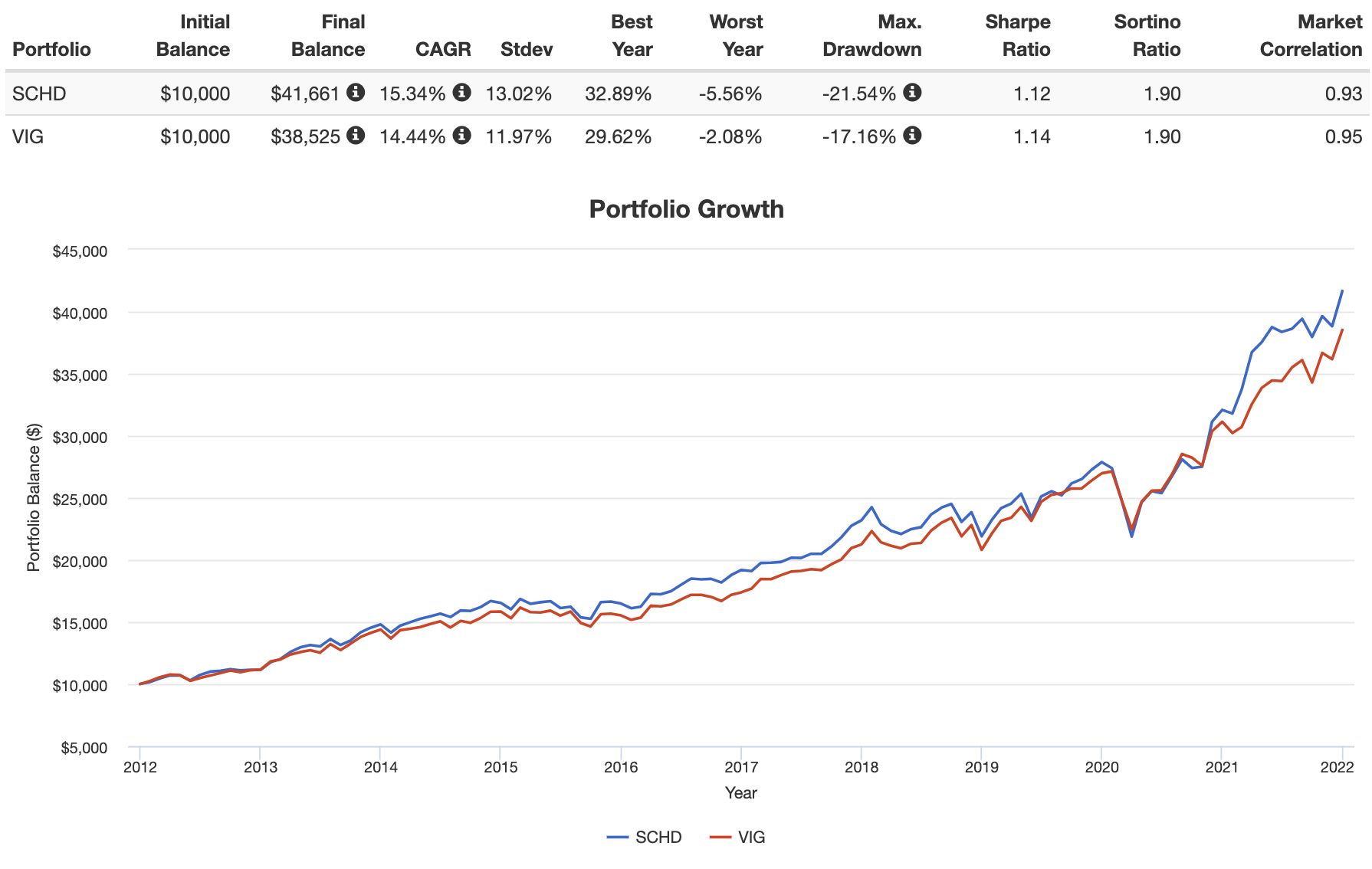
schd vs vig performance

VIG has slightly outperformed SCHD over the total period, but notice how this was basically due to VIG pulling away in 2025 after recovering faster from the dip early in the year. Prior to that, SCHD was ahead most of the time. These 2 funds delivered a nearly identical risk-adjusted return, and VIG exhibited lower volatility and a smaller max drawdown, which was the March 2020 crash.

SCHD vs. VIG – Conclusion

I created a dividend-focused portfolio that incorporates both of these funds that can be found here.

But remember what I noted in my comparison of VIG and VYM: Vanguard themselves investigated the strategies of funds like these and concluded that their constituent stocks’ performance was fully explained by their exposure to known equity factors like Value, Profitability, etc., so if you don't care about using dividends as income, you may be better off – in terms of total return – by simply investing in products that specifically target those factors, like a small cap value fund.

Keep in mind too that in choosing one of these funds, you may be missing out on some sectors entirely, like REITs for example, which are usually coveted by yield chasers.

Conveniently, both SCHD and VIG should be available at any major broker, including M1 Finance, which is the one I'm usually suggesting around here.

Do you hold either of these ETFs in your portfolio? Let me know in the comments.


Disclaimer:  While I love diving into investing-related data and playing around with backtests, this is not financial advice, investing advice, or tax advice. The information on this website is for informational, educational, and entertainment purposes only. Investment products discussed (ETFs, mutual funds, etc.) are for illustrative purposes only. It is not a research report. It is not a recommendation to buy, sell, or otherwise transact in any of the products mentioned. I always attempt to ensure the accuracy of information presented but that accuracy cannot be guaranteed. Do your own due diligence. I mention M1 Finance a lot around here. M1 does not provide investment advice, and this is not an offer or solicitation of an offer, or advice to buy or sell any security, and you are encouraged to consult your personal investment, legal, and tax advisors. Hypothetical examples used, such as historical backtests, do not reflect any specific investments, are for illustrative purposes only, and should not be considered an offer to buy or sell any products. All investing involves risk, including the risk of losing the money you invest. Past performance does not guarantee future results. Opinions are my own and do not represent those of other parties mentioned. Read my lengthier disclaimer here.

m1


Are you nearing or in retirement? Use my link here to get a free holistic financial plan and to take advantage of 25% exclusive savings on financial planning and wealth management services from fiduciary advisors at Retirable to manage your savings, spend smarter, and navigate key decisions.

retirement peace of mind

Related Posts

  • 3 Best SPAC ETFs To Invest in SPACs in 2025 – But Should You?
  • How To Consolidate and Refinance Credit Card Debt
  • The 5 Best Schwab ETFs for Low-Fee Indexing
  • 3 Best Floating Rate Bond ETFs – USFR vs. TFLO vs. FLOT
  • The 10 Best Large Cap Value ETFs (4 From Vanguard) for 2025

About John Williamson, APMA®

Analytical data nerd, investing enthusiast, fintech consultant, Boglehead, and Oxford comma advocate. I'm not a big fan of social media, but you can find me on LinkedIn and Reddit.

Reader Interactions

Leave a Reply Cancel reply

Your email address will not be published. Required fields are marked *

Primary Sidebar

  • Facebook
  • Instagram
  • Reddit
  • Twitter
  • YouTube
  • Patreon

Join 5,372 other investors

Take control of your financial future by subscribing to receive exclusive emails with expert tips, news, and notifications of new posts and important updates.

Don't worry, I hate spam too. No ads.

John Williamson, APMA®

Analytical data nerd, investing enthusiast, fintech consultant, Boglehead, and Oxford comma advocate. I'm not a big fan of social media, but you can find me on LinkedIn and Reddit. Read More…

Most Popular

Ray Dalio All Weather Portfolio Review, ETFs, & Leverage (2025)

HEDGEFUNDIE’s Excellent Adventure (UPRO/TMF) – A Summary

Golden Butterfly Portfolio Review and M1 Finance ETF Pie

David Swensen Portfolio (Yale Model) Review and ETFs To Use

55 Lazy Portfolios and Their ETF Pies for M1 Finance (2025)

VIG vs. VYM – Vanguard’s 2 Popular Dividend ETFs (Review)

Warren Buffett ETF Portfolio (90/10) Review and ETFs (2025)

Bogleheads 3 Fund Portfolio Review and Vanguard ETFs (2025)

Paul Merriman Ultimate Buy and Hold Portfolio Review & ETFs (2025)

The Best M1 Finance Dividend Pie for FIRE & Income Investors

m1 sidebar

retirable

Portfolio Asset Allocation by Age – Beginners To Retirees

The 7 Best Small Cap ETFs (3 From Vanguard) for 2025

9 Best International ETFs To Buy (6 From Vanguard) in 2025

The 3 Best Inverse ETFs to Short the S&P 500 Index in 2025

Ben Felix Model Portfolio (Rational Reminder, PWL) ETFs & Review

Factor Investing and Factor ETFs – The Ultimate Guide

NTSX ETF Review – WisdomTree U.S. Efficient Core ETF (90/60)

The Ginger Ale Portfolio (My Own Portfolio) and M1 ETF Pie

TQQQ – Is It A Good Investment for a Long Term Hold Strategy?

QYLD – Avoid This ETF as a Long-Term Investment (A Review)

The 9 Best T Bill ETFs (Treasury Bills) To Park Cash in 2025

JEPI ETF Review – JPMorgan Equity Premium Income ETF

SPAXX vs. FZFXX, FDIC, FCASH, FDRXX – Fidelity Core Position

Recent Posts

M1 Earn High Yield Cash Account Review – 4% APY (2025)

RSBY ETF Review – Return Stacked® U.S. Bonds & Futures Yield ETF

1 ETF for Life to Get Rich? It’s Not One You’d Guess…

How to Get 35% off a New Tesla Model Y (1.99% APR Financing Promo)

M1 Finance New Dividend Reinvestment Features Are Here! (Sneak Peek)

RSSY ETF Review – Return Stacked® U.S. Stocks & Futures Yield ETF

RSBT ETF Review – Return Stacked® Bonds & Managed Futures ETF

RSST ETF Review – Return Stacked® US Stocks & Managed Futures ETF

CAOS ETF Review – Alpha Architect Tail Risk ETF

How to Get 33% off a New Tesla Model Y (0.99% APR Promo)

CALF ETF Review – Pacer U.S. Small Cap Cash Cows 100 ETF

Is THIS the Best Portfolio?

AVMA ETF Review – Avantis Moderate Allocation ETF (60/40 + Factors)

COWZ ETF Review – Pacer U.S. Cash Cows 100 ETF

BOXX ETF Review – Alpha Architect 1-3 Month Box ETF

View All...

Footer

  • Facebook
  • Instagram
  • Reddit
  • Twitter
  • YouTube
  • Patreon

Amazon Affiliate Disclosure

OptimizedPortfolio.com is a participant in the Amazon Services LLC Associates Program, an affiliate advertising program designed to provide a means for sites to earn advertising fees by advertising and linking to Amazon.com.

Email Newsletter

Sign up to receive email updates when a new post is published.

Don't worry, I hate spam too. No ads.

About - My Toolbox - Privacy - Terms - Contact


Copyright © 2025 OptimizedPortfolio.com