SCHD is a popular dividend ETF from Schwab to capture profitable U.S. stocks with a sustainable dividend. But is it a good investment? I review it here.
First, note that I don't chase dividends. But I recognize that many investors use dividends to supplement their current income, particularly in retirement. Others just irrationally prefer dividend-paying stocks. I even designed a dividend-focused portfolio for income investors that uses SCHD as its primary holding; I'll explain why below.
Disclosure: Some of the links on this page are referral links. At no additional cost to you, if you choose to make a purchase or sign up for a service after clicking through those links, I may receive a small commission. This allows me to continue producing high-quality content on this site and pays for the occasional cup of coffee. I have first-hand experience with every product or service I recommend, and I recommend them because I genuinely believe they are useful, not because of the commission I may get. Read more here.
Contents
SCHD Review Video
Prefer video? Watch it here:
SCHD ETF Quick Stats Table
Before we get into the details on SCHD, here are the quick stats:
| Inception Date | October 20, 2011 |
| Expense Ratio | 0.06% |
| AUM | $86 billion |
| Index | Dow Jones U.S. Dividend 100 Index |
| Holdings | 104 |
| Dividend Yield | 3.43% |
| Weighted Avg. Market Cap | $112 billion |
| Portfolio P/E | 17.3 |
| CAGR (since inception) | 13% |
SCHD ETF – Intro
SCHD is the Schwab U.S. Dividend Equity ETF. The fund is a very popular dividend ETF from Schwab that launched in late 2011. Since then, the fund has amassed over $85 billion in assets.
SCHD has become one of the most talked-about ETFs on the internet, and also seemingly one of the most misunderstood. Spend 5 minutes in any finance community on Reddit or Twitter and you'll find someone claiming SCHD is the ultimate retirement income machine, someone else calling it a drag on long-term growth, and a third person posting a screenshot of their “yield on cost” as if that's a meaningful metric (it isn't).
The reality is more nuanced and more interesting than either camp admits. For a pretty humble low-cost Schwab ETF, SCHD is genuinely a strong fund, but not for the reasons most people think. Its potential edge isn't the dividends. It's the quality screening methodology that accidentally captures the same factor premiums academic researchers have spent decades documenting. Understanding the distinction matters, because it determines whether SCHD belongs in your portfolio at all. We'll cover all this in detail more below.
SCHD has a little over 100 holdings and aims to capture companies with a reliable dividend history and robust profitability. Its market cap weighted index is the Dow Jones U.S. Dividend 100 Index. SCHD can be described as a large cap value fund. On average, larger stocks are more stable, are less risky, and have more predictable cash flow than smaller stocks. Value stocks have also outperformed growth stocks historically due to what we believe is a risk premium.
Though it may appear so at first glance, SCHD is not just your typical, simple dividend fund. It first looks for companies with 10 years of consecutive dividend payment history and a minimum market cap of $500 million, and then employs earnings screens to attempt to capture high-quality companies with strong profitability that can pay a sustainable dividend going forward.
Next we'll look at the specifics of this selection methodology.
SCHD ETF Index Selection Methodology
Let's look at the specific details of the selection methodology of SCHD, because it's more involved than you might suspect.
SCHD's methodology is more rigorous than most dividend ETFs. Its index is the Dow Jones U.S. Dividend 100 Index. Starting from the broad Dow Jones U.S. market, the index immediately excludes REITs, MLPs, preferred stocks, and convertibles, a design choice that meaningfully filters out the yield traps and tax-inefficient structures that litter the high-dividend space.
From the remaining universe, stocks must clear four eligibility hurdles:
- 10 consecutive years of uninterrupted dividend payments – This single requirement eliminates the majority of U.S. equities and serves as a blunt but effective quality proxy.
- Minimum $500 million float-adjusted market cap
- Minimum 3-month average dollar trading volume (liquidity screen)
- Above-median indicated dividend yield relative to eligible peers.
Eligible stocks are then ranked on an equal-weighted composite of four fundamental financial signals:
- Free cash flow to total debt
- Return on equity
- Indicated annual dividend yield
- Five-year dividend growth rate
The top 100 composite scorers make the cut. Holdings are weighted by modified market cap, with a 4% cap on individual holdings and a 25% sector cap to prevent runaway concentration. The index reconstitutes annually in March, rebalances quarterly, and since 2018 has conducted monthly dividend cancellation reviews so that dividend cutters can be removed between annual reconstitutions rather than waiting out the year.
Let's briefly talk about the REITs exclusion. REITs are required to distribute 90%+ of taxable income as dividends, which means they'd look attractive on a raw yield screen, but their ROE and free cash flow profiles don't reflect the same quality signals as C-corps, and most REIT distributions include non-qualified return-of-capital components. Excluding them keeps the quality composite honest and, as a side effect, makes SCHD's distributions predominantly qualified dividends for tax purposes.
Now let's look at the resulting sector weightings of this construction.
SCHD Sector Breakdown
Here's where SCHD's sector breakdown sits after the 2026 reconstitution, compared to what the S&P 500 holds:
| Sector | SCHD | S&P 500 |
|---|---|---|
| Consumer Staples | 19.4% | ~6% |
| Healthcare | 18.9% | ~12% |
| Energy | 16.3% | ~4% |
| Industrials | 11.8% | ~9% |
| Information Technology | 11.2% | ~31% |
| Financials | 8.9% | ~13% |
| Communication Services | 7.0% | ~9% |
| Consumer Discretionary | 6.4% | ~10% |
| Basic Materials | ~0.1% | ~2% |
| Utilities | ~0% | ~3% |
| Real Estate | 0% | ~2.5% |
S&P 500 sector weights are approximate as of early 2026.
A few things worth unpacking here.
Broadly speaking, for being essentially a US large cap dividend fund, SCHD is pretty well diversified across sectors aside from a negligible weight to Utilities and its excluding REITs entirely. But the fund naturally tilts toward some traditionally “defensive” sectors like Consumer Staples and Industrials.
At 11.2%, SCHD has meaningfully improved its tech weight from the historical 7-8% floor – UnitedHealth, Texas Instruments, Qualcomm, and Accenture now give it some texture there – but it still sits 20 percentage points below the currently-tech-heavy S&P 500. For context, the “tech sector” alone in the S&P 500 is larger than SCHD's top 3 sectors combined.
The 10-year dividend history requirement is the structural reason for that. NVIDIA, Meta, Amazon, and Alphabet remain ineligible until their dividend histories mature (and even then, their yields will likely be too low to rank in the composite basket). Plainly, SCHD is not going to give you massive tech exposure that many seem to want these days after it has soared in recent years.
Financials basically got cut in half. Before March 2026, Financials were often SCHD's largest sector. Now they're 6th. Banks and insurance companies got crowded out by Healthcare and Consumer Staples names with stronger composite scores, primarily because their dividend growth rates have been uneven post-2022 and their debt/FCF profiles look worse under the methodology's screens as interest rates normalize. Whether that's a timely or mistaken tilt remains to be seen; it's a snapshot in time, not a forecast.
Energy remains elevated at over 16%. It was 23%+ immediately after the 2025 reconstitution and has since been trimmed by both price appreciation in energy names and pruning of Valero, Halliburton, CF Industries, and Ovintiv. 16% is still 4x the S&P 500's allocation. SCHD's methodology doesn't cap sector bets at S&P 500 weights; the 25% sector ceiling is the only governor.
Consumer Staples at nearly 20% is the closest thing SCHD has to a permanent overweight. Coca-Cola, PepsiCo, Procter & Gamble, and Colgate have been recurring fixtures in the fund for a long time now. Their 10-year dividend histories are pristine, their ROE profiles are consistent, and their yields remain attractive relative to the broad market. These are expected characteristics of Consumer Staples.
The tradeoff is that Consumer Staples has been one of the weakest-performing S&P 500 sectors over the past few years as investors rotated aggressively into growth. That pattern tends to reverse during recessions and volatility spikes – exactly when you'd want a 20% Consumer Staples allocation – but it's been a headwind during (relatively) calm, growth-led markets.
Real Estate being absent is, again, a deliberate choice that income investors should factor in explicitly. If you're building a dividend portfolio around SCHD, you're arguably leaving an entire income-generating asset class on the table. Something like VNQ can fill that gap, but it requires a separate position.
The broader takeaway is that SCHD's sector composition is the direct result of its methodology applied to current market prices, not a discretionary call or a macro bet. The flip side is that the math can produce concentrations that look awkward in hindsight (see 23% Energy in 2025). Understanding the sector weights as a byproduct of quality screening rather than an active investment thesis helps calibrate expectations when a particular sector has an off year.
SCHD Top 10 Holdings
Current top 10 holdings for SCHD after the 2026 reconstitution are as follows:
| Holding | Approx. Weight |
|---|---|
| Texas Instruments | ~4.5% |
| UnitedHealth Group | ~4.4% |
| Chevron | ~4.3% |
| Merck | ~4.2% |
| ConocoPhillips | ~4.2% |
| Coca-Cola | ~4.0% |
| PepsiCo | ~3.95% |
| Amgen | ~3.8% |
| Verizon | ~3.8% |
| Procter & Gamble | ~3.8% |
These top 10 represent roughly 40% of assets. The fund is modestly concentrated by ETF standards, as it only has 100 holdings.
SCHD reconstitutes every March, and the 2026 edition was one of the largest in the fund's history at roughly 31% portfolio turnover, with 25 names added and 22 removed. Notable exits included Cisco, AbbVie, Valero, Halliburton, and Janus Henderson (acquired by Franklin Templeton). Notable additions included UnitedHealth, Abbott, Procter & Gamble, Qualcomm, Accenture, ADP, and Blackstone.
SCHD Performance
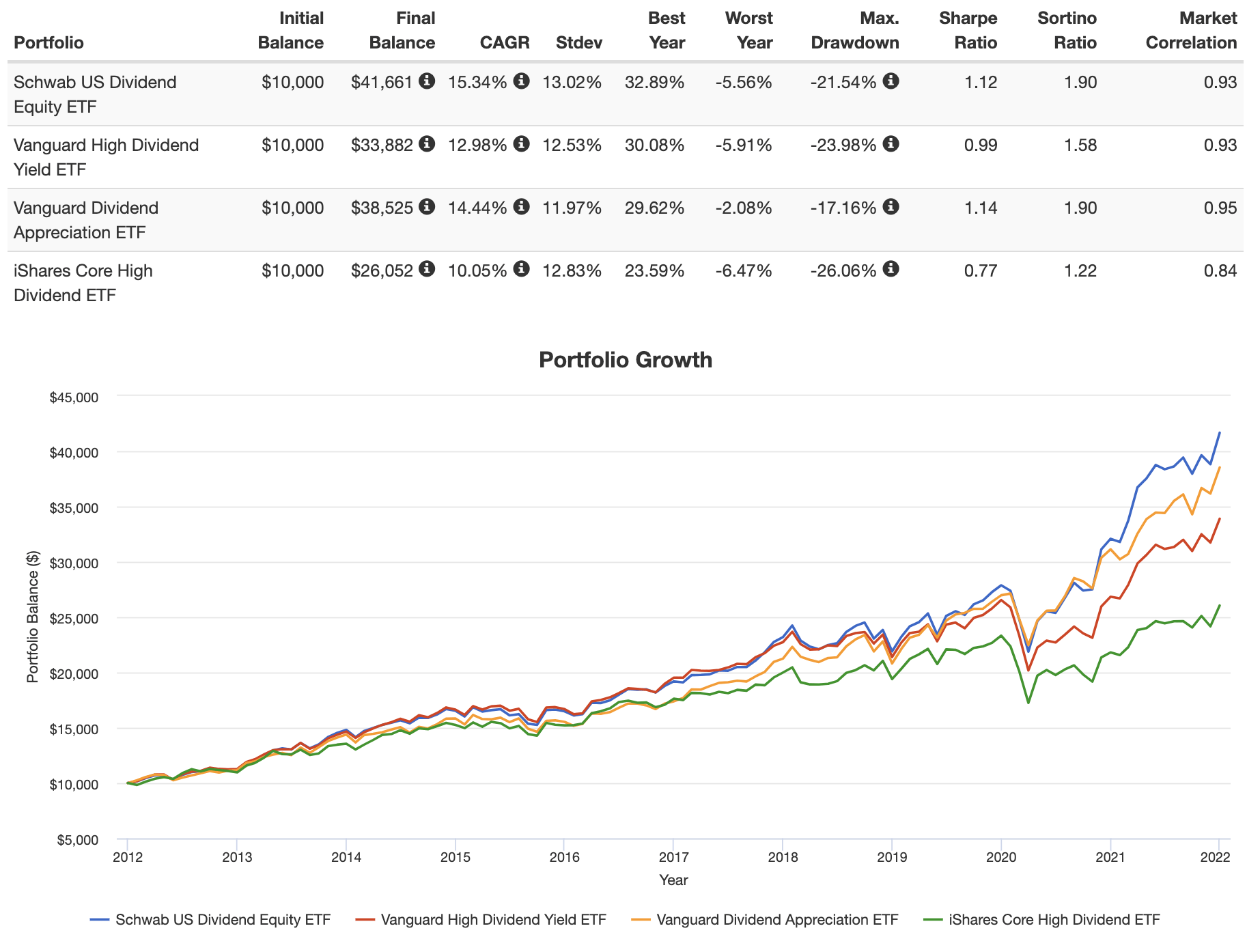
From inception in 2011 through early 2026, SCHD has delivered right at a 13% annualized total return, behind SPY/VOO at 15% over the same window but ahead of VYM (12.7%), and roughly matching VIG.

In terms of volatility, SCHD runs about 15.5% annualized, slightly less than 17% for the S&P 500 for the same period.
SCHD's maximum drawdown was -33.4% during the COVID crash in March 2020, nearly identical to the S&P 500.
On those data points, pause and appreciate that SCHD is neither more “stable” nor “safer” than the S&P 500 in any meaningful sense. I see both those erroneous claims frighteningly often.
If one wanted to lower volatility and risk, we'd turn to other uncorrelated asset classes, like bonds and gold, not dividend stocks. Thinking dividend stocks are tangibly “safer” than the broader stock market is like saying you're buying the slower Ferrari instead of the faster Ferrari.
As a result, risk-adjusted return measurements Sharpe, Sortino, and Calmar are all still lower for SCHD than for the S&P 500 over the same period.
Annual total returns look like this:
| Year | SCHD | S&P 500 | Spread |
|---|---|---|---|
| 2012 | +16.5% | +16.0% | +0.5% |
| 2013 | +32.5% | +32.4% | +0.1% |
| 2014 | +11.4% | +13.7% | -2.3% |
| 2015 | -3.2% | +1.4% | -4.6% |
| 2016 | +17.4% | +12.0% | +5.4% |
| 2017 | +18.6% | +21.8% | -3.2% |
| 2018 | -5.6% | -4.4% | -1.2% |
| 2019 | +28.5% | +31.5% | -3.0% |
| 2020 | +11.5% | +18.4% | -6.9% |
| 2021 | +29.2% | +28.7% | +0.5% |
| 2022 | -3.2% | -18.1% | +14.9% |
| 2023 | +4.6% | +26.3% | -21.7% |
| 2024 | +11.7% | +25.0% | -13.3% |
| 2025 | +4.3% | +15% | -10.7% |
Again, remember SCHD's 10-year dividend history requirement necessarily excludes the stocks that drove essentially all of the S&P 500's outperformance during this period. NVIDIA went public in 1999 but only initiated a dividend in 2012 and has grown it at a tiny nominal rate. Meta didn't pay dividends until 2024. The Magnificent 7 represented roughly 60%+ of the S&P 500's returns in 2023, and SCHD owned none of them.
Of course, as I hinted at earlier, we'd expect a quality-screened dividend fund that holds 100 stable, established, dividend-paying businesses to lag a cap-weighted index dominated by hyper-growth tech companies during the latter's extended bull run. That's the trade-off.
The flip side showed up in 2022, when SCHD fell just 3.2% while the S&P 500 dropped 18.1%. Value stocks clobbered Growth stocks for 2022, and SCHD holds mostly Value stocks. If Value makes an extended comeback in the US, it will be SCHD's time to shine again.
Historical (Hypothetical) Index Performance
Here's a fun fact that rarely gets mentioned in SCHD discussions: If we look at SCHD's index's hypothetical backtested data going back to 1999, well before the fund's inception, it has actually beaten the S&P 500.
But before you get too excited, it's worth understanding exactly what this means in this context.
The Dow Jones U.S. Dividend 100 Index index was launched for live calculation on August 31, 2011. SCHD began trading 2 months later. Everything before August 2011 is explicitly disclosed by S&P Dow Jones Indices as “hypothetical (back-tested), not actual performance.“
The index has a First Value Date going back to December 31, 1999, but 12 of those years are simulated history, not real money doing real trading with a real fund.
This matters because two of the index's core selection rules are powerfully backward-looking when applied retroactively:
- The 10-year consecutive dividend history requirement – applied in, say, March 2001 – automatically excludes any company that would go on to cut its dividend during the dot-com bust. In real time, you wouldn't know which companies those were.
- The four-factor quality composite (ROE, FCF-to-debt, indicated yield, 5-year dividend growth) was finalized in 2011 with full knowledge of which factor combinations had worked over the prior decade.
This is textbook look-ahead bias – designing a methodology in hindsight to explain what already happened, then calling the result “historical performance.” At the least, investors should view the pre-launch data with a handful of skepticism.
With that caveat out of the way, here's what the official S&P DJI numbers show. The following table draws from S&P Dow Jones Indices' own “Dividend Strategy with Quality Yields” paper, with performance data through mid-2023. The pre-2011 figures are hypothetical; everything from 2011 onward is live index data:
| Period | DJ U.S. Dividend 100 | S&P 500 (Broad Market) | Spread |
|---|---|---|---|
| 2000-2002 Dotcom Bust (hypothetical) | +17.1% cumulative | -44.3% cumulative | +61.4% |
| 2007-2009 Financial Crisis (hypothetical) | -44.5% peak-to-trough | -50.8% peak-to-trough | +6.3% |
| 10-year annualized (live, as of mid-2023) | 11.81% | 12.28% | -0.47% |
| 15-year annualized (partially hypothetical) | 11.79% | 10.63% | +1.16% |
| 20-year annualized (majority hypothetical) | 11.68% | 10.16% | +1.52% |
Source: S&P Dow Jones Indices, “Dividend Strategy with Quality Yields,” July 2023. Pre-2011 figures are hypothetical back-tested data.
The +17% through the dot-com bust deserves an explicit disclaimer. That's a nice positive return while the broad market was down a massive 44%. In real time, that would have required holding essentially zero technology stocks through the late 1990s bubble while everyone around you was posting triple-digit gains.
Any rules-based fund running a 10-year dividend history screen would have avoided most of the bubble names, but the magnitude of the outperformance is almost certainly inflated by the hindsight-informed quality composite and the survivor bias inherent in applying 2011-era rules to 1999 data.
The 2007-2009 figures are arguably a bit more credible. A 6% cushion during a broad financial crisis – where financial leverage was the primary killer – is consistent with what a genuine quality tilt (low debt, high ROE) would actually deliver.
In any case, I'd submit that the more important, broader takeaway from all this is realizing that Value stocks crushed Growth stocks for roughly that decade of 2000-2010 right before SCHD's actual launch, so it should be no surprise that the hypothetical index data beat the market for that period. Again, the specific magnitude thereof is debatable.
SCHD Dividend History, Yield, and Growth
Of course, people are buying SCHD for its dividend focus, so let's talk about that briefly.
At the time of writing, the fund has a dividend yield of 3.43%.
SCHD has grown its annual dividend by roughly 11% annually since inception, a rate that essentially no competing dividend ETF matches over the same window. For context, 5-year dividend growth rate for both VYM and HDV is roughly 5%, and even VIG – which explicitly prioritizes dividend growers – runs at about 9%.
Of course, at the end of the day, this shouldn't mean too much, as dividends are just one component of total return, and the smaller one at that.
But if for some reason you plan to “live off the dividends” in retirement, a 3.43% yield on $1.5 million generates roughly $51k annually. At 10% dividend growth, that income doubles about every 7 years, which should easily outpace inflation and provide a growing cash stream without requiring portfolio withdrawals. This is probably SCHD's strongest use case for income-focused retirees. The behavioral benefit of not needing to sell shares to generate income may be useful, even if theoretically suboptimal.
SCHD pays dividends quarterly. The Q4 payment is typically the largest due to special dividends from underlying holdings settling at year end.
SCHD Tax Efficiency and Account Placement
SCHD is a relatively tax-efficient dividend fund, but “relatively efficient” still means less efficient than not receiving the dividend at all (or a total market index fund with a lower dividend).
The good news is nearly 100% of SCHD's distributions qualify as qualified dividends, eligible for long-term capital gains rates rather than ordinary income rates. The REIT exclusion and ETF structure obviously contribute to this relative tax efficiency too. The fund has essentially never distributed capital gains in its 14-year history.
The bad news is dividends are still taxable events in the year they occur, even if you immediately reinvest them. Every quarterly payment from SCHD in a taxable account creates a tax bill. Contrast this with VTI or VOO, which generate most of their returns through unrealized price appreciation that you only pay taxes on when you choose to sell.
Fidelity's reported tax-cost ratio for SCHD is approximately 1.2%, versus 0.7% for VYM and 0.5% for VTI and VOO. Compounded over 30 years, the after-tax gap between SCHD and a total market fund is meaningful for high earners in high-tax states.
As such, SCHD is obviously best held in a tax-advantaged account like a Roth IRA. Qualified dividends make it tolerable in taxable accounts for investors in the 0% bracket, but high earners should treat it as a tax-inefficient holding and choose total market funds for taxable space.
Is SCHD a Good Investment?
So is SCHD a good investment? Maybe.
I'm not a dividend investor, but SCHD may be my favorite dividend fund, but the reason has nothing to do with dividends. I'll explain.
The Factor Story
SCHD's long-run outperformance versus VYM and HDV isn't a dividend story. It's a factor story.
When we run SCHD's monthly returns through a Fama-French 5-factor regression since inception, we find statistically significant positive loadings on Value (HmL), Profitability (RmW), and Investment (CmA), beta of roughly 0.85, and a modestly negative Size (SmB) loading. Factors are independent sources of risk that explain the differences in returns between diversified portfolios.
I delved into factors in a separate post here. As I've noted elsewhere, the historical success of dividend investing as a whole is largely rooted in these factor premia.
In plain English for the uninitiated, SCHD looks like a portfolio of moderately cheap, highly profitable, conservatively financed large-cap U.S. companies, which is exactly what it selects for. And it costs “only” 0.06%.
This nontrivial factor exposure is not an accident, but it wasn't really intentional either. The index methodology predates much of the modern factor literature, and it was created with dividend practitioners in mind, not academic researchers.
But let's briefly return to SCHD's screens to show how this happens in practice:
- Return on equity is a standard profitability measure.
- Free cash flow to debt captures financial conservatism.
- A 10-year dividend history screens out distressed and speculative firms.
- Indicated yield captures cheapness.
As a result, SCHD basically stumbled into roughly the same factor exposures as purpose-built quality funds like QUAL and SPHQ, and at a lower fee.
The details of factors are beyond the scope of this post, but the practical implication is SCHD's expected pre-tax total return should approximately match a comparable factor-tilted portfolio without the dividend constraint. The dividends are not the source of returns; they're a byproduct of selecting high-quality, profitable businesses, many of which happen to return capital to shareholders as cash.
But there's the rub. We've known for decades now that the performance of dividend stocks is fully explained by these known factor exposures, and we now have products to directly target those factors, which is more efficient and more effective and typically carries less of a tax drag because the dividend constraint is irrelevant.
So if you're considering SCHD for its dividends per se, maybe it's for you. But if you're liking it for its methodology, consider following that thought to its logical conclusion by ditching the dividend requirement and finding a similar (or, likely, superior) factor-oriented fund with similar screens.
Bogleheads will correctly point out that adding SCHD alongside VTI is functionally a value tilt rather than true diversification. You're not adding a new return stream; you're concentrating more into a subset of U.S. Value stocks. Such a core-satellite approach with, let's say, 10% SCHD, would not be dramatically different from just holding the total market, but would still naively provide nonzero factor loadings for the portfolio.
Essentially, SCHD is a pretty decent factor fund that's disguised as a dividend fund, and, in my opinion, is a strong contender for the best dividend fund out there. That's why I made it the primary holding in the dividend portfolio I designed for income investors.
If factor premia persist, SCHD may beat the market over the long term. This is another misunderstanding I see often on Reddit and Twitter. People think that because SCHD is a “stable” dividend fund (we already showed it's not very “stable” anyway), that it must necessarily lag the market always. This is not true. It has only been true in recent years due to the stellar performance by big tech, which we already noted is severely lacking in SCHD.
Again, if Value makes a strong, extended comeback in the U.S., be ready for SCHD's outperformance. The Value spread is still looking juicy in early 2026.
Cons of SCHD
In fairness, let's also recall some not-so-great things that we touched on earlier that are worth thinking about before buying SCHD:
- Chronic tech underweight is structural, not temporary. SCHD currently sits at ~11% technology versus ~30% for the S&P 500. The 10-year dividend history requirement excludes mega cap tech names. This is baked into the methodology. The 2023 and 2024 underperformance wasn't bad luck; it was the logical, expected outcome of holding zero Magnificent Seven exposure during a period when those seven companies drove the majority of market returns.
- Sector timing risk from annual reconstitution may be impactful. A 31% portfolio reshuffling in a single month is not nothing. The March 2025 reconstitution pushed Energy to 21% of the fund immediately before energy underperformed the S&P by ~7 points. These are not random events; the methodology systematically buys recent underperformers and sells recent outperformers, but it introduces meaningful sector timing risk that novice investors will underestimate or overlook.
- REIT exclusion arguably limits income diversification. If you're an income investor, real estate is a legitimate income-generating asset class that SCHD systematically ignores. You'd need to separately own a REIT fund to fill that gap.
- The “11% dividend growth” extrapolation is optimistic. Past dividend growth does not guarantee future dividend growth. The base of distributions has grown substantially, and at some point the law of large numbers applies. Several individual holdings have also cut dividends during the fund's history (triggering removal), which mutes the per-holding growth rate.
- Tax drag in taxable space is not trivial for high-income and high-state-tax investors versus a plain total market index fund, much less a large cap Growth fund.
- On the scale of possible diversification, SCHD is still low. We're still just talking about a basket of 100 US large cap Value stocks at the end of the day here. Basically no international stocks, Growth stocks, mid caps, or small caps.
- SCHD is an accidental factor fund, but we can probably find more efficient products with which to target factors more directly.
Who SCHD Is and Isn't For
SCHD may be for you if:
- You're using tax-advantaged accounts where dividend drag doesn't apply.
- You want a naive quality/value tilt alongside a total market core.
- You're in the 0% qualified dividend bracket and dividend tax drag is minimal.
- You understand that SCHD will trail the S&P 500 during growth-led bull markets and accept that tradeoff.
- You're okay with a chronic technology underweight relative to the broader market.
SCHD is probably not for you if:
- You're a high earner holding it in a taxable account in a high-tax state.
- You think the 11% dividend growth rate will continue indefinitely at the same pace.
- You're looking for significant tech exposure in your portfolio.
- You want to diversify beyond 100 U.S. large cap Value stocks.
- You desire an investment that is truly safer and less volatile than the S&P 500. SCHD is not.
Conveniently, SCHD should be available at any major broker, including M1 Finance, which is the one I'm usually suggesting around here.
What do you think of SCHD? Let me know in the comments.
Disclaimer: While I love diving into investing-related data and playing around with backtests, this is not financial advice, investing advice, or tax advice. The information on this website is for informational, educational, and entertainment purposes only. Investment products discussed (ETFs, mutual funds, etc.) are for illustrative purposes only. It is not a research report. It is not a recommendation to buy, sell, or otherwise transact in any of the products mentioned. I always attempt to ensure the accuracy of information presented but that accuracy cannot be guaranteed. Do your own due diligence. I mention M1 Finance a lot around here. M1 does not provide investment advice, and this is not an offer or solicitation of an offer, or advice to buy or sell any security, and you are encouraged to consult your personal investment, legal, and tax advisors. Hypothetical examples used, such as historical backtests, do not reflect any specific investments, are for illustrative purposes only, and should not be considered an offer to buy or sell any products. All investing involves risk, including the risk of losing the money you invest. Past performance does not guarantee future results. Opinions are my own and do not represent those of other parties mentioned. Read my lengthier disclaimer here.

Are you nearing or in retirement? Use my link here to get a free holistic financial plan and to take advantage of 25% exclusive savings on financial planning and wealth management services from fiduciary advisors at Retirable to manage your savings, spend smarter, and navigate key decisions.


Leave a Reply